This algorithm simply takes an element, and places it in its correct position. By placing such element in its correct position, the rest of the elements are right shifted by 1.
This algorithm works similarly to the way you might sort playing cards in your hand. You start with one card, and then pick up one card at a time, inserting it into the correct position among the previously sorted cards. The array is divided into a “sorted” section and an “unsorted” section. With each iteration, the algorithm takes an element from the unsorted section and places it in the correct position in the sorted section.
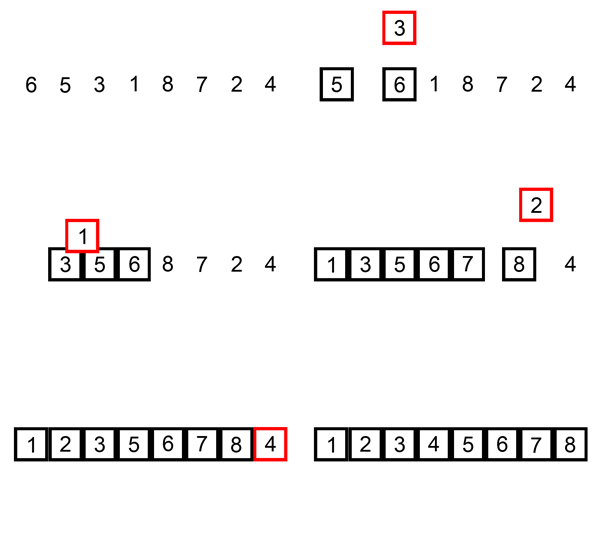
The time complexity is also O(n²).
For instance, given an array of 9, 14, 15, 12, 6, 8, 13 - this is how the insertion sort
algorithm will work.
- First checks if only
9is at its right position. - Second, it checks between
9, 14to see if14is at its right position - Third, it checks between
9, 14, 15to see if15is at its right position - Fourth, it checks between
9, 14, 15, 12to see if12is at its right position - if its not, it places12right after9- but it doesn’t do it instantly. First it will swap the positions of12and15. Then it will swap the positions of12and14.
So it basically swaps swaps swaps until it cannot be swapped anymore.
The pseudocode for this algorithm would be as follows:
for(int i = 0; i < n - 1; i++){ j = i; while(j > 0 && a[j-1] > a [j]) { swap(a[j-1], a[j]) j--; }}Here’s how it would look like in C++:
void insertion_sort(int arr[], int n){  for (int i = 1; i <= n-1; i++){    int j = i;    while(j > 0 && arr[j-1] > arr[j]){      int temp = arr[j - 1];      arr[j-1] = arr[j];      arr[j] = temp;
      j--;    }  }}