Recursion is a method where a function calls itself to solve smaller instances of the same problem. It is particularly useful for divide and conquer problems; however, it can be difficult to understand exactly what is happening, since each recursive call is itself spinning off other recursive calls.
Every recursive function must have two parts:
- Base case – a condition where the recursion stops. Without one, a recursive call lasts forever until a stack overflow/segfault occurs.
- Recursive case – the part where the function calls itself with a smaller or simpler input.
Understanding recursion comes down to recognizing how each call reduces the problem and how the base case eventually stops the chain of calls. A simple problem that naturally lends itself to a recursive solution is calculating factorials. The recursive factorial algorithm defines two cases: the base case when n is zero, and the recursive case when n is greater than zero.
def factorial(n): #test for a base case if n == 0: return 1 else: # make a calculation and a recursive call f = n * factorial(n - 1) print(f) #print intermediate results (optional) return (f)How Recursion Works
Let’s say we are tasked to print a number from 1 to n using recursion. Below is how the code would look like:
def more(n):    if n < 1: # base case        return    more(n - 1)    print(n)
more(3)
First of all, note how we check if n < 1 and then we return / exit execution of the function.
This is called a base case. Normally, a recursion call lasts forever until a stack overflow/segfault
occurs. In order to prevent this, we add a base case to terminate the recursive calls. Now the
above function prints “1, 2, 3”.
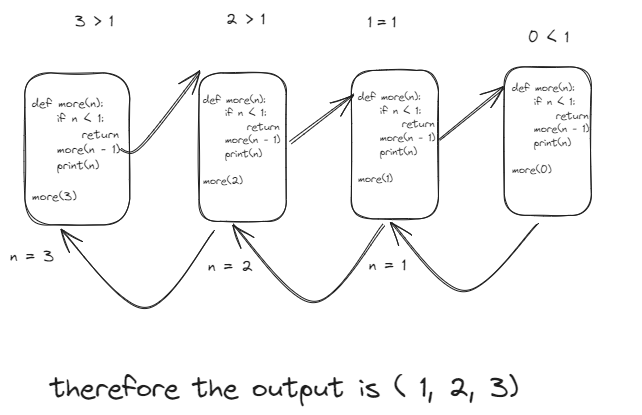
When we call the function more(3):
- We check if the base case is true -> it is not since
3 > 1 - We call the function itself with a decrement of n. This calls the same function again in the
recursive tree. So the function
more(3)hasn’t stopped executing. - We go to the 2nd function
more(3 - 1), check for the base case and recall the same function in the recursive tree. - We keep doing that until the base case becomes true, only then do we return/break the
functions executions…therefore printing
non each function exit.
This is how the recursive call looks like visually:
How to Think Recursively
When approaching a recursion problem, always follow these steps:
- Identify the base case. What is the simplest version of the problem that can be solved directly?
- Assume the recursive call works. Trust that your function correctly handles smaller inputs.
- Build the current step. Use the result from the smaller problem to solve the larger one.
- Test with small inputs. Tracing a small example (like n = 3) helps you understand how calls stack and return.
Recursion becomes easier once you realize that you are breaking a big task into smaller self-similar tasks until you hit the simplest possible one.