Key points about the Queue interface
- FIFO — a
Queuefollows First-In-First-Out: elements are added at the rear and removed from the front. - Insertion and removal operations —
Queuesupports insert, remove, and examine. For insertion:add(E e)oroffer(E e). For removal:remove()andpoll(). To examine or retrieve without removing:element()andpeek(). - Exception-throwing vs. non-exception-throwing methods — each operation has two variants:
one throws an exception on failure, the other returns a special value (
nullorfalse). For example,add(E e)throwsIllegalStateExceptionif no space is available, whileoffer(E e)simply returnsfalsein the same scenario.
Methods the Queue interface provides:
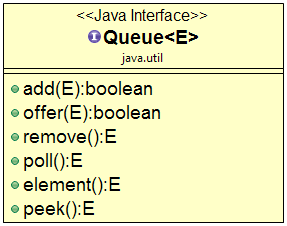
Queue interface with its LinkedList implementation
public class QueueExample {    public static void main(String[] args) {        // Create and initialize a Queue using a LinkedList        Queue<String> elementQueue = new LinkedList<>();
        // Adding new elements to the Queue (the enqueue operation)        elementQueue.add("element1");        elementQueue.add("element2");        elementQueue.add("element3");        elementQueue.add("element4");
        System.out.println("WaitingQueue : " + elementQueue);
        // Removing an element from the Queue using remove() (the dequeue operation)        // remove() throws NoSuchElementException if the Queue is empty        String name = elementQueue.remove();        System.out.println("Removed from WaitingQueue : " + name + " | New WaitingQueue : " + elementQueue);
        // Removing an element from the Queue using poll()        // poll() is like remove() except it returns null if the Queue is empty        name = elementQueue.poll();        System.out.println("Removed from WaitingQueue : " + name + " | New WaitingQueue : " + elementQueue);    }}
More Queue methods
public class QueueSizeSearchFrontExample {    public static void main(String[] args) {        Queue<String> elementQueue = new LinkedList<>();
        elementQueue.add("element1");        elementQueue.add("element2");        elementQueue.add("element3");        elementQueue.add("element4");
        System.out.println("WaitingQueue : " + elementQueue);
        // Check if a Queue is empty        System.out.println("is waitingQueue empty? : " + elementQueue.isEmpty());
        // Find the size of the Queue        System.out.println("Size of waitingQueue : " + elementQueue.size());
        // Check if the Queue contains an element        String name = "Johnny";        if (elementQueue.contains(name)) {            System.out.println("WaitingQueue contains " + name);        } else {            System.out.println("Waiting Queue doesn't contain " + name);        }
        // Get the element at the front of the Queue without removing it, using element()        // element() throws NoSuchElementException if the Queue is empty        String firstElementInTheWaitingQueue = elementQueue.element();        System.out.println("Waiting Queue (element()) : " + firstElementInTheWaitingQueue);
        // Get the element at the front of the Queue without removing it, using peek()        // peek() is like element() except it returns null if the Queue is empty        firstElementInTheWaitingQueue = elementQueue.peek();        System.out.println("Waiting Queue : " + firstElementInTheWaitingQueue);    }}